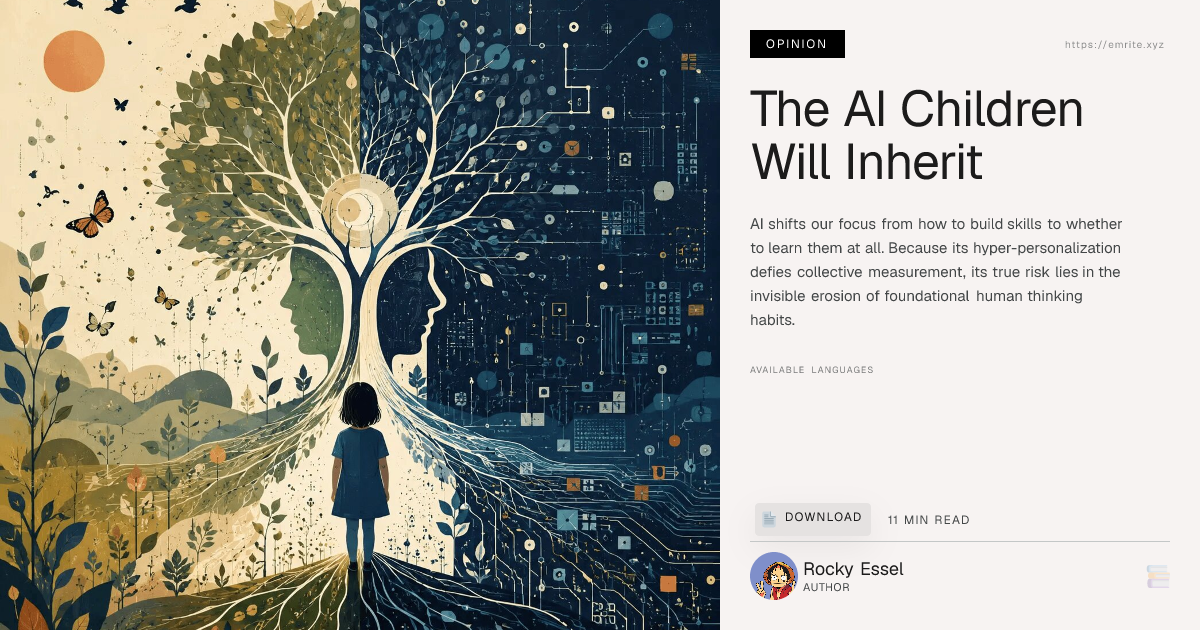
There was a time where the future was easier to imagine when progress was slower and more predictable. One generation could predict the next thing with reasonable confidence and data to back it up, like the jobs children would have, the skills they would need, even the shape of adulthood itself.
Artificial intelligence disrupted that picture by changing what humans are expected to be and then, suddenly, capabilities that once defined our value, like writing, reasoning, teaching, creative stuff etc became eroded.
The greatest impact of AI may not ultimately fall on us, even though many of us are already feeling it through work, education, and daily life. Its deepest impact may fall on the children who will never know a world without it, children who will grow up not wondering whether AI can do something, but whether they should bother learning to do it themselves.
The Acceleration Problem
Nearly every major prediction made since the arrival of modern generative AI has aged faster than expected. We know prediction depends on relatively stable variables, and that assumption is no longer safe since change has accelerated so rapidly that the data used to forecast the future evolves month by month, sometimes week by week.
And when variables shift this quickly, any fixed prediction expires before it can even be lived or even tested. In an era of accelerating change, we need flexible frameworks or method rather than fixed techniques, mental models adaptable enough to survive our current shifting environments. And note, how forecasts intended to describe the lives of future generations are already describing ours, the predictions about automation a few years ago, AI-assisted work (Anthropic just release a new feature), and changing education were once discussed as distant possibilities, they are now our present realities. How do we prepare even ourselves let alone the current generation and future generation of children for a version of adulthood that does not yet exist?
To understand the scope of this shift, we have to look at the immediate gains, what social media did to us, the unique measurement problem AI creates, and the invisible cognitive friction we are actively giving up.
The AI Gains
People are using it to communicate better. Someone who struggled their entire life to express themselves in writing is now sending clear, confident emails. Someone who did not know how to start a difficult conversation with a parent, a partner, or a boss has found the words. People are using AI to understand things that were previously locked behind years of expensive education, complex medical diagnoses, legal documents written in language, technical concepts that required a degree to decode. People who felt profoundly alone have found something that listens without judgment, without distraction, without checking its phone.
People are using AI to build businesses that would have been impossible five years ago. A single person in a small city with no team and no funding is now able to build software, design products, run marketing, handle customer service, and analyze data at a scale that used to require twenty people and millions of dollars in investment. The barriers that kept most of the world's ideas from becoming real, access to expertise, access to capital, access to tools, are collapsing in real time, and this is one of the most significant redistributions of capability in human history.
Developers are building in hours what used to take weeks. Researchers are synthesizing information across hundreds of academic papers in the time it used to take to carefully read one. Doctors are catching diagnoses earlier. Teachers are personalizing learning in ways classrooms never allowed. Musicians are finding sounds they never knew they were looking for. People who could not afford therapy are having conversations that help them understand themselves better. People who could not afford lawyers are navigating systems that were designed to be navigated only with expensive help.
The productivity gains are real. The access gains are real. The creative gains are real. We are already fifty percent into a world where AI assistance is the infrastructure. Every major company is building with it or building on it. Every individual who has engaged with it seriously has found something that changed how they work. The question is not whether AI is powerful. It clearly, undeniably is. The question is what that power is quietly doing to us while we are busy being productive inside it.
Social Media is different
To understand what AI might do to a generation that grows up entirely inside it, it will helps us to first understand what social media did to the us, and specifically why the lessons we learned from social media will not transfer cleanly to AI.
Social media changed how young people understood themselves in relation to the world. Researchers continue to debate the precise size and causes of its effects, but a substantial body of evidence has linked heavy social media use to higher rates of depression, anxiety, loneliness, and body-image concerns, particularly among the youths.
The mechanism, once understood, was not especially mysterious. People did not post their ordinary lives. They posted the highlight reel. The holiday, not the debt that paid for it. The relationship, not the arguments inside it. The body after months of work, not the body on an ordinary Tuesday. What appeared on the screen was not reality but a carefully selected version of reality. And yet, the human brain compared it to reality anyway, therefore, the comparison that was made by these individual was never fair, and for many people it came at a psychological cost that researchers are still trying to fully understand.
But here is what is important, we figured it out. Not quickly, and not without real damage, but we eventually figured it out. Screen time tools were built (prominently by Google and Apple). Awareness campaigns were run, parents learned to talk to their children about the difference between a highlight reel and a real life, researchers published studies, journalists wrote investigations and governments held hearings.
The reason we were eventually able to understand social media's effects is that, while the experiences varied from person to person, the underlying mechanisms were remarkably consistent. The details differed, but the psychological patterns were often the same, social comparison, idealized self-presentation, and the fear of missing out.
AI does not work this way, and this is the part that should make us pay very close attention.
The Measurement Problem
Social media, for all the harm it caused, had one property that made it possible to study and eventually to partially address, the content, while vast, was not truly personal. When a platform shows you a post, it is showing some version of that post to millions of other people. The algorithm customizes your feed, but the underlying content, the images, the videos, the lifestyles being displayed, is the same content rotating through different combinations for different users. The harm it caused was, in the end, a collective harm. The same images caused the same damage in the same way across enough people that the pattern became visible.
An interaction with AI is not like this. When you talk to an AI, the response you get is generated specifically for you, in that moment, in response to your exact words, your exact context, your exact state of mind as expressed in that conversation. No one else gets that response. No one else has that conversation. The AI is not broadcasting a message to millions of people simultaneously. It is having a unique, individual, dynamically generated interaction with one person at a time. And that interaction adapts to you, your language, your concerns, your emotional state, your history within the conversation, in a way that no piece of social media content ever could.
This is exactly what makes AI so powerful and so useful, and the reason is that, the personalization, the personalization is the product, and the fact that it responds to you, specifically, with something tailored to your exact situation, that is why it feels so different from everything that came before it, which makes the potential harm almost impossible to measure using the tools we built to measure social media.
Now, I want to be precise about what I mean when I say AI's effects are harder to measure, because I am not saying measurement is impossible. We can still measure things like loneliness, emotional dependency, changes in productivity, or how much someone relies on a tool rather than their own thinking. Those signals are real and researchers are already tracking them, what becomes much harder to measure is the outcome, meaning what the interaction actually did to that specific person, how it changed the way they think, what it reinforced or eroded in them, and because this interaction itself was unique to them, the effect that is produced is also unique to them. Two people can become dependent on AI in measurable ways and still arrive at that dependency through entirely different conversations, for entirely different reasons, with entirely different consequences for who they are becoming.
And that's the distinction that has to be known, and with social media, the input and the outcome were both collective enough to study together. With AI, we can measure the outcome in aggregate, but we lose the ability to connect it cleanly to the input, because the input was different for every single person, and that gap, between what can measure and what we can explain, is where the real danger I believe lives.
The Calculator Inside Your Head
Let us come down from the abstract for a moment and talk about a specific, concrete, personal example of the mechanism underneath all of this.
I had a teacher who gave us, his students advice that sounded entirely reasonable, he said, "use the calculator, do not waste your time doing arithmetic by hand, or in your head, since we are going to be calculating things far more complex than basic addition and multiplication, and that's why the calculator exists, and that's what tools are for, so use them".
It was practical, and honestly it is forward-looking, and it stuck with me so thoroughly, and so early, that the mental model for basic arithmetic, the one that gets built through the small friction of working sums in your head, through the practice of holding numbers in your mind and manipulating them, through that repetition builds fluency, just atrophied from disuse, and before I realized what I've done to myself, I was standing at a market stall, trying to quickly add up whether the total being asked for is correct before I hand over money to the seller, the hesitation, the pause and mumbling if the total I had calculated in my head was correct, and the fact that I was unsure and tried reaching my the phone, that was a moment of pure, and genuine embarrassment for me, , was the difficult numbers I couldn't do in my head.
Now, I don't believe that the teacher was not wrong, calculators are useful, but what he failed to account for was that those simple calculations are not just calculations. They were the training ground for my mental habits that make more complex thinking possible. Every time we hold numbers in our head, we work through a problem, and arrive at an answer without assistance, we are building our cognitive capacity.
I remember very well, after the moment, I started watching videos on Youtube on addition, subtraction and multiplications, which was a very humbling experience for me, and also by watching them I stopped after a day or two, and realize the issue was not that I couldn't add them, it was the fact doing it in my head without any physical visual aid was the issue, so I hard to learn those math tricks to calculate faster, to make up for the fact that my mental model for math was broken.
This is the mechanism I'm talking about, if we offload a cognitive task to a machine, we weaken the very capability that task was helping us develop. The calculator is a simple example. If basic arithmetic is delegated too early, the mental habits that come from doing it yourself may never fully form.
The Horseshoe Blacksmith
Now, let's think about a blacksmith in the era of horse-drawn transport, where this blacksmith, his name is John, makes horseshoes. John is extremely skilled, respected, and essential to the whole economy of transportation, because transportation relies entirely on horses, and horses need shoes.
If you traveled back in time and told John that, in the future, horseshoes would be completely irrelevant, he would try to understand that reality using the only framework he has. He would ask questions like, Will horseshoes be mass-produced? Will the quality drop? Will shoes be made of different metals? John thinks about the future of horseshoes because horseshoes define his world. He cannot conceive of cars, commercial planes, or a society so thoroughly restructured that his entire trade becomes a niche historical artifact, and at that moment, the scale of change is simply outside his conceptual toolkit.
Now, I like to think, we are John, the blacksmith, and AI is not just a better horseshoe, and the thing that makes me wonder that is, whenever we try to imagine what AI will do to children growing up inside it, we instinctively use today's way of thinking, we ask questions that make sense to us because they come from the world we know, and the value we hold.
We ask whether children will become worse at mathematics or whether they will write less well or whether they will lose the ability to code or whether they will become less creative, less independent, or too dependent on AI. We ask what jobs AI will replace, which university degrees will still matter, and debate whether prompt engineering or context engineering is the skills employers will value.
I mean, these are all reasonable questions, but are all based on our current values and knowledge now, but they may also be horseshoe questions.
They assume that today's abilities are still the right abilities to measure. They assume that writing, coding, memorizing, reasoning, and problem-solving will remain the same kinds of skills they are today, and that the only question is whether AI makes people better or worse at them.
What's already happening
There are already signals worth paying attention to.
There are documented cases of people developing serious emotional dependencies on AI systems. And if someone had told most of us before 2022 that people would form deep emotional attachments to a chatbot, many of us would have laughed.
A robot? Maybe. We know popular culture has spent decades preparing us for that idea, but a chat interface running on a screen? A conversation box connected to a language model? And even now, the suprising thing is that, not many people believe this happened.
There are people who describe their relationship with an AI chatbot as the most important relationship in their lives. Some report genuine distress when the service becomes unavailable or when a model update changes the personality they had grown attached to. Others have withdrawn from human relationships they find less responsive, less validating, or simply less satisfying by comparison. And these are all documented cases that have appeared in journalism, research, and clinical discussions over the past few years.
And in terms of skills, there are workers in multiple industries who have discovered that their AI-assisted productivity came at the cost of skills they did not realize they were losing until they needed them. Radiologists who catch AI-flagged findings but increasingly struggle with cases where the AI finds nothing and the pathology is subtle. Lawyers who can produce AI-assisted briefs efficiently but find their independent legal reasoning has grown rusty. Writers who can generate content quickly but have lost the ability to sit with a blank page and produce something original from genuine thought.
Now think about this what I've mentioned above, these are adults, people who spent years learning their craft before AI arrived, and yet the same people are beginning to notice something uncomfortable, that their skills that once felt natural after years of experience now require more effort, and also requires them to think harder than before, and in most cases, they become to dependent on the tool than they intended.
And I can relate to that myself. When I started writing this article, I found myself, staring at a blank screen for nearly an hour, I rewrote the introduction multiple times, and struggled to find a version I was at least happy with, and what made the realization hit harder for me, that after months of using AI to help generate ideas, code, improve certain workflow of mine, I was no longer as comfortable facing the blank page alone as I once was.
What the Children Will Inherit
This is where I become most uncertain. I am not a developmental psychologist, and I am not a parent. What I say here comes from pure observation, from watching the children around me and trying to understand how they actually learn. And since they learn through the raw friction of experience, they touch what they are told not to touch, they fall, adjust, and try again. Over time, through trial and consequence, they build their understanding of the physical and mental world.
I do not believe children will be able to avoid AI. By the time today’s toddlers are in school, AI will be deeply embedded in how they write, learn, and create. By the time they enter the workforce, it will be as ordinary and ambient as electricity. Which raises a question for us, at what point do children struggle long enough to build the unique cognitive abilities that only struggle can produce? But then again, maybe I'm just asking the wrong questions, since maybe I am only worried about this because my own framework of the world is fixed, and I am trying to measure their future using my past.
And it's easy to look at the current landscape, where students are already struggling with basic reading, writing, and reasoning. Our immediate instinct is to ask whether AI belongs in the classroom at all, or if we are accidentally outsourcing the foundations of thought. But that might be a horseshoe question.
Conclusion
I considered ending this article with a list of recommendations. Use AI this way. Do not use it that way. Protect these skills. Teach those habits.
But the more I wrote, the less certain I became. I rewrote this article several times, and each version made me realize the same thing, every recommendation I came up with was built from the world as I understand it today. Then if I'm right, I am trying to imagine a future from inside a framework that may not survive in a few or any moment from when this article is published. So I stopped trying to offer answers.
Also, I do not think certainty is what this moment requires, I think it requires attention, curiosity, humility, and a willingness to notice what is changing before we rush to explain it. Maybe, years from now, much of what I have written here will turn out to be wrong, which I would be perfectly happy if it is. But I would be far more concerned if we never asked these questions at all.
Every generation inherits a world shaped by the one before it. But imagine what it means for this generation to inherit a world where intelligence is no longer confined to human experience, but is a permanent feature of their very surroundings, and also, the children who will answer those questions are still growing up, and by the time they can tell us what it was like to inherit AI, many of the choices that shaped their world will already have been made.